So I haven’t really done much minimizing around my house since my last post. One day, I looked through my nightstand and wanted to keep everything, including the book light that I probably use once a year (because it’s cozy to read under the covers in the dark sometimes). I really have no need of a book light, because even when my husband is home, he has the ability to sleep while I read with the lamp on. I’ve quickly discovered how attached I am to material possessions that I do not need, or use.
My next attempt to declutter was my clothing. I have a dresser and a small closet. Here I realized how much I’ve accumulated in recent years. I’ve written about capsule wardrobes and Project 333 on this blog in the past. I may have taken the easy way out by deciding to do Project 333 again. I’m keeping out only 33 items, including outerwear, accessories, and shoes, for three months (in this case, until spring). I chose my 33 items, and threw away two stained items and four ratty socks. I am donating two pairs of jeans that don’t fit right, and I packed up the rest. I now have three plastic bins full of clothes in the basement (that I’m procrastinating going through). When I used to do this, I think I had only one partially full plastic bin in the basement. Apparently, I’ve been accumulating clothing.
Today, I was upstairs with the girls and I looked at the books, the DVDs, and the puzzles. I declared that I will be decluttering those soon, but not today.
I think I may have a little fear about getting started. I recalled that I had fear before beginning the Belly Fat Bootcamp Challenge. I wasn’t exactly sure how it would go. Would I be able to keep up with the exercises and cooking the food? Now, I’m five weeks in and it doesn’t seem so difficult.
I’m definitely seeing similarities between my taking care of my body and taking care of my home. I go through spurts where I work out and eat healthy foods, and when they end, I go back to my old sugary food habits and not working out much. I’m also good at decluttering and organizing for a time, and then stopping before I get to the results I really want. You could call it yo-yo dieting, yo-yo exercising, and yo-yo minimizing. Surely, I could choose to change my lifestyle permanently in both areas, couldn’t I?
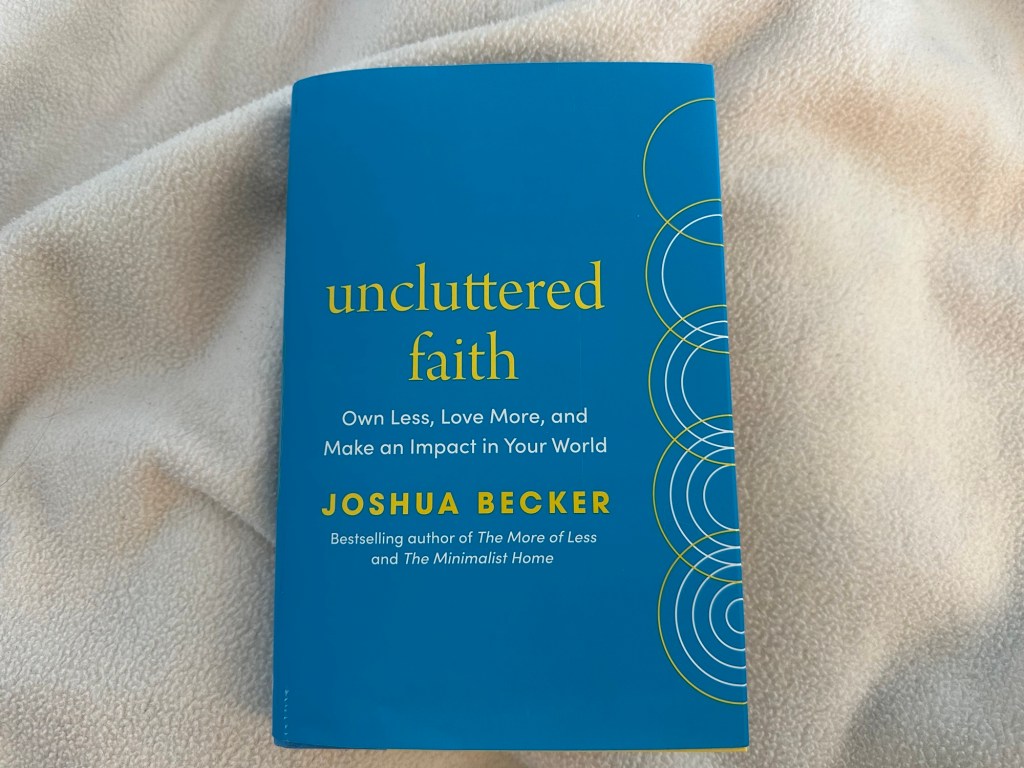
I think I need a change in attitude. I finished reading the book uncluttered faith. At the end, there is a bonus section called The Becker Method: A Seven Step Guide to Becoming Minimalist. Here is a quote from Step 2:
… it is so important to focus on the positives at the beginning and throughout this process. Rather than dwelling on what you’re losing, celebrate what you’re gaining. Instead of being motivated by the negatives of consumerism, you’ll find greater momentum by thinking about the positives of minimalism. This is why this book has focused exclusively on the spiritual benefits and blessings of owning less. (Pg. 207)
This stood out to me as something that I haven’t done consistently. I keep tending to focus on what I can’t eat. I focus on those Super Bowl cupcakes in the pantry, the bag of peanut M&Ms on the counter, or the smell of the frozen pizza in the oven. I think of how long it’s gonna take me to finish a workout. I could just as easily focus on my smaller waist, the definition starting to appear in my arms, or how blessed I am to be able to go to the store and buy ground chicken and protein powder, which can be quite expensive. I could be grateful for my health.
I could also be grateful for the material possessions that I use everyday or every week. Instead of being afraid that I might someday need something that I don’t use very often, I could focus on the freedom I will feel when I choose to live more simply. Maybe I’ll be less scattered and distracted. I can think of the time I will have to spend on what really matters to me now, instead of being sad to lose something I used to use in the past and no longer need.
This book really does lay out many of the benefits to owning less. It also discusses many of the Gospel teachings, which I know so well, but I don’t follow so well. This is something that I will certainly pray about. It’s easy to think that these teachings will not lead to happiness, even though I know that God wants what’s best for me. I’ll end with a quote from the book related to this, that I found encouraging.
This was my attitude – until I actually started living out Jesus‘s teachings on money and possessions. As soon as I did, I began to understand on a deeper level that all God‘s greatest blessings lie on the other side of obedience. There is a better life for us in all His commands, including the ones to give away money and belongings. (Pg. 12)
Oops! The number of books I am currently reading, according to my Goodreads app, is 16. I just keep starting new books and not finishing the old ones. Today, I am determined to write a blog post. I have many ideas swirling around in my mind. Now that I’m writing, I can see two main ideas that I would like to talk about. One is “helplessness” and the other is “minimalism or spiritual poverty and faith”.
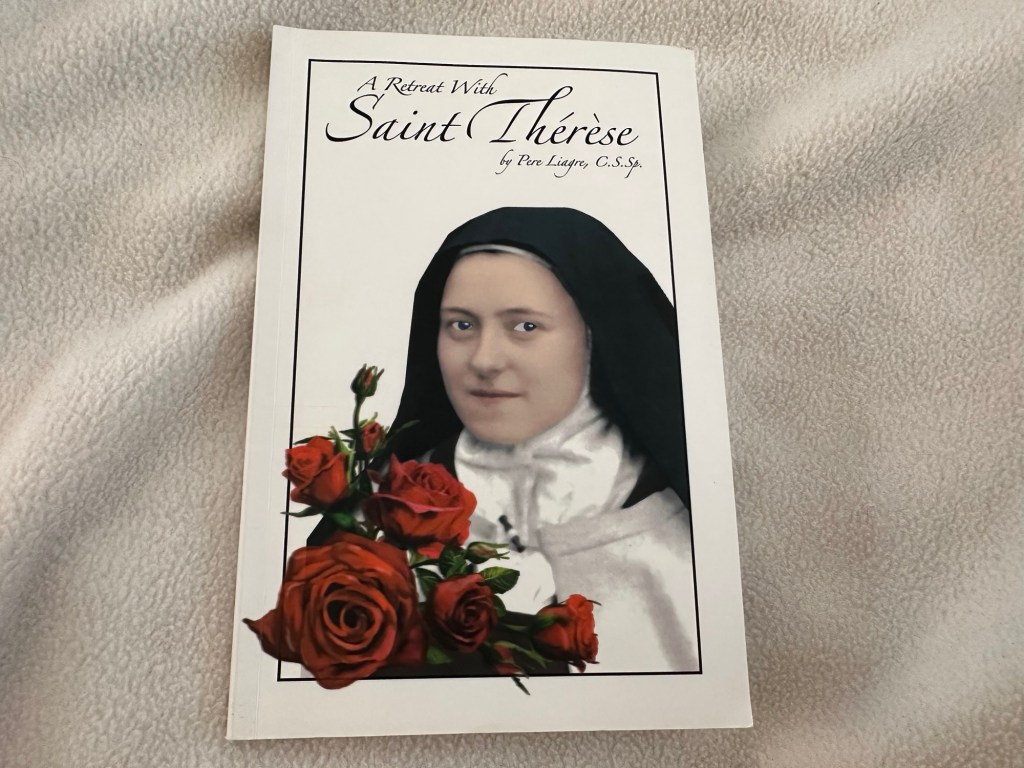
The first comes from a book I’ve been reading, with a group of Catholic women, called A Retreat with Saint Therese. According to Goodreads, I started reading this book 9 months ago. That’s probably right. A woman in my neighborhood likely started this group in April of last year. We met twice a month, took a very long break in the summer and fall, and started meeting again in January.
The second comes from two books. UnclutteredFaith by Joshua Becker and Happy Are You Poor by Fr. Thomas Dubay. I read the latter many years ago and I just started reading the Becker book last night. It’s clear to me now that I’m not ready to talk about those quite yet. 
So helplessness it is! You probably already know a lot about this famous saint, but if not, here is a quick and oversimplified explanation to give some context. Saint Therese talks about wanting to find a very direct little way to heaven, instead of taking the steep staircase, which she believes she is too little to climb. She tries to find a lift to carry her up to Jesus. She realizes that the lift is the arms of Jesus. Here is a paragraph from the book regarding this:
Enlightened by the Holy Ghost, Therese perfectly understood these words of Wisdom. “To be wholly little,” that is to say, to know and love our helplessness, and for that reason “to go to Him,” that is to Infinite Love; this is how we enter the lift. And then He carries us up; He does it, not we ourselves. All we have to do is not to interfere, to yield ourselves to His upward movement. He lifts us up above ourselves, above our wretchedness and our shortcomings, and, little by little, will free us from our ourselves, from our egoism! That is His work, His essential work. He will do this divine work if, while desiring its realization in us, we rely in no way on ourselves, but rather, fearlessly, unhesitatingly and unreservedly on Him, on His gratuitous and all-powerful Love. The desire to love, humility, confidence; that is all.
(Page 41)
I included the whole paragraph because the whole thing is great, but the part that has stuck in my mind for a month is: “to know and love our helplessness.” This was a new idea to me. Not knowing my helplessness. I’m grateful that I often know it. And intellectually, I understand, and have experienced, surrendering, (usually out of desperation) and relying unreservedly on Him. I have often been humbled and realized I need to stop interfering and let Him do his work. The new idea for me was to love my helplessness. Have I ever done that? I don’t think so. How am I going to be “wholly little”? This has been in the back of my mind.
I wondered if I ever wanted to be little. Was there a time when I wanted to be helpless? Do I even want to become like a little child? Did I love being a child when I was a child? I think I was usually rather serious. But I could be silly too.
I remember that day when I was playing with my sister in the finished basement of our home, and my mom called us upstairs. My brother was there and my mom sat us down on the couch. She told us that she and my dad were getting a divorce. I think I started crying. It gets a little blurry. I remember my mother giving me paper grocery bags and me filling one with my shoes and one with my stuffed animals. And I think she told me I needed clothes. We were trying to get out of the house before my dad got home and we were going to stay with my grandparents. I remember feeling like an observer that day. Watching my grandmother bring my mother a drink. Sitting on my grandparents’ couch as they discussed something… I don’t remember feeling anything. I was nine, my brother was eight, and my sister was four.
That was in the spring. In the fall, I went to a new school. I wrote about the divorce in the assigned essay about what I did that summer. I wrote about how it was the best thing for everybody. How my parents were not happy together and now they would be happy. Looking back now, it’s clear that I wanted people to think I was fine.
I continued with this strategy. I was calm, cool and collected. My mother said I handled disappointment well. My grandmother said I wasn’t moody, I always had the same disposition. I was proud that my hands didn’t shake and I didn’t have panic attacks. I was proud of my good grades. I thought of myself as strong. I acted like I didn’t care what people thought of me. I became a helper, a problem solver, a good listener. I became a people pleaser. I don’t think I wanted to be helpless or needy or dependent. As an adult, I never wanted to go back to my childhood.
So here I am now at 56 years old. I’ve learned some truths over the years. I’m aware that I’ve believed a lot of lies. I think the more time I spend in the Presence of the Blessed Sacrament, the more real I become. I am able to know my helplessness and my dependence, and also my loveableness. Today, while I was praying, I felt completely seen inside and out. It was as if I dropped everything I would have hidden behind in the past. And I kind of liked it. It gave me hope that I could one day love my helplessness. Maybe I would like to be little.
Amazingly, the Magnificat Meditation of the Day (2/10/26) seemed to fit my situation this morning.
Discouragement… springs from self-love and is a rebellion against our littleness and poverty. We do more harm to ourselves by yielding to discouragement over our imperfections, than by falling through weakness, because we deprive ourselves of the means of getting back up again. Discouragement shows too how defective is our trust in God. God comes to our help in proportion to our confidence and littleness, measuring his gifts by our trust. The Lord needs nothing but our humility and confidence to work his miracles and marvels. Such childlike trust makes us more apt for the working of his consuming and transforming love.
God does not intend his mercy to stop with us as individuals, however. We are to offer to others the pardon we ourselves have received. Confronting our own sinfulness is liberating, enabling us to put away the mask of untruthfulness and to be fully ourselves before God and those around us. It also means that we are not scandalized by the weakness of others, knowing that we share in it in a mysterious way through our common humanity…
(Sister Mary David Totah, O.S.B.)
I see this as encouragement to desire greater humility and confidence in God. I’ll admit I’ve been desiring to love my helplessness ever since I read that line. And I’ll end with another encouraging passage from the book:
This is what she says: “I have always longed to become a saint, but, alas, I have always found that when I compare myself to them, there is the same difference that we see in nature between the mountain peak lost in the clouds, and the tiny grain of sand trodden under the feet of the passers-by. Far from being discouraged, I say to myself: God would never put unrealizable desires into our hearts…” Let us pause here for a moment. The saint’s reasoning is admirable. God, the Holy Ghost, never inspires the soul with desires that cannot be gratified. He only awakens desires in order to satisfy them, and more completely than we can imagine or ask for.
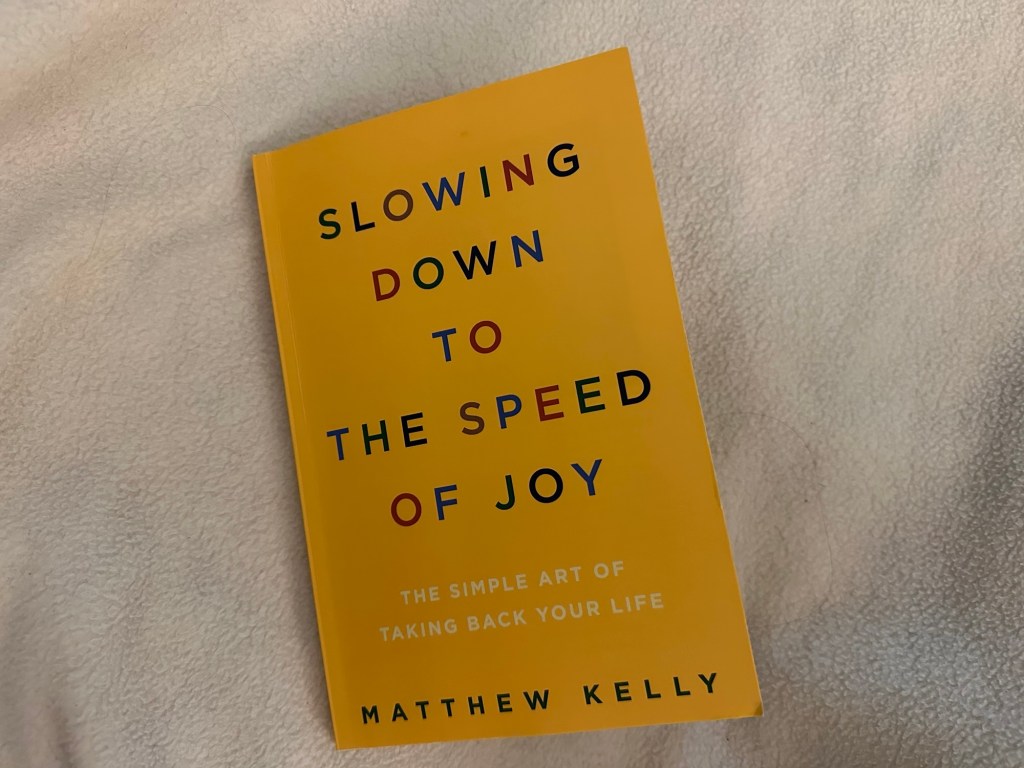
Today, I want to write about a connection I made between Slowing Down to the Speed of Joy and Groundhog DayThe Musical.
It happened when I read these lines from the book:
A life dominated by urgent, busy and hurry is incompatible with the health and well-being of the human person, and incompatible with the things we say matter most.
Take relationships as an example. Love says: “I see you. I hear you. I am with you. I care. Rest a while. You are safe here with me. You are worthy.” (Pg. 7)
“Love says: I see you…” I immediately thought of the song “Seeing You” from the musical. I thought of how Phil Conners was stuck in the time loop until he slowed down, was humbled, accepted his situation as it was, and loved other people.
You may not have seen the play. For many years, I wanted my kids to see Broadway plays with me. No one ever wanted to, until one day in 2017, when Joseph asked me to take him to New York to see Groundhog Day The Musical. And so we went. It was very much like the movie, but with wonderful songs. And if you haven’t seen the movie, I highly recommend it. I’m planning on rewatching it this year on February 2nd. Also, if you don’t want the story to be spoiled for you; then you should stop reading this post right now. I’m gonna tell the story of the musical in my own words.
Phil Connors is a self-centered and arrogant weatherman. He is going to a small town in Pennsylvania, called Punxsutawney, to report on the groundhog coming out. Will he or will he not see his shadow? The townsfolk celebrate and enjoy Groundhog Day, but Phil thinks it’s lame and doesn’t wanna be there. His attitude seems to be saying, “let’s just get this over with” and I think he has an underlying belief that tomorrow is going to be better.
Well, it turns out a big snowstorm (that he didn’t predict) comes in and he’s stuck there overnight along with his coworker, Rita. When he wakes up in the morning, it is Groundhog Day once again. He is stuck in a time loop; reliving the same day over and over again.
Before I continue with the story, I wanted to mention another song from the musical that I like called “One Day”. It ends Act One, and at the end of the song, the whole cast is involved and people are singing things that they will do one day.
I’ll cut down on fried chicken takeaway… one day I will do it… one day I’ll stop drinking so much… some day, I’ll buy her that ring… and the one that gets me is this: one day I’ll get a new safety clip for my holster… It opens too quick… I’ll do it next week…
How often do I put things off until tomorrow or next week? Procrastination can be a trap just as easily as urgency can be. But let’s get back to the story.
Phil goes through thinking he’s mental and visiting doctors. He wastes time getting drunk, philandering, eating, stealing money and other things that don’t make him happy. He spends time trying to end his life and is unsuccessful. Next he tries to learn everything about his coworker Rita to get her to love him. It can’t be done in one day. So he tells her what’s going on with him and she gives him more ideas of what he could do with this time. He could learn things, fix mistakes, help people…
For a while, he tries to stop a homeless man from dying on Groundhog Day. (I believe the song during this is called “Night Will Come”. It ends with some foreshadowing. This line is repeated three times: You’ve gotta love life…) He must accept the fact that he can’t stop the man from dying. And he finally accepts that he’s stuck in the time loop.
Neither the movie, nor the Broadway play, say how long he’s stuck in it. Some people on the Internet have estimated 30 to 40 years, in order for him to learn all the things he learned to do, and include all of the time he wasted.
This brings us to “Seeing You”. I think this link will bring you to the song if you want to hear it. I love this song.
I’m a sucker for conversion stories. I love to see attitudes change for the better. And in this story, it’s Phil’s humility that allows him to slow down, and accept the moment exactly as it is, and to have love and gratitude.
He slows down by letting go of working so hard to change his situation.
As Matthew Kelly says:
Busy prevents us from enjoying the things we are doing. (Pg. 8)
You can see this clearly in the movie when Phil is trying to fit everything into one day to make Rita fall in love with him and he’s getting stressed and irritable, which is making her even less likely to fall in love with him. He is still being selfish at that point, working at his own agenda.
The speed of our lives prevents us from recognizing the subtlety of human emotion and the people around us. (Pg. 9)
Slowing down and seeing Rita is what makes him attractive to her.
Other lyrics from “Seeing You”:
Trying to forecast the future
Always staying a day ahead
Well, that was the idea
And I’m here
How often do I project into the future in an attempt to be prepared for it? How often do I worry about things that never happen? How often do I miss what’s right in front of me? There are just so many relatable ideas in this story. 
OK, that’s enough about Groundhog Day. I definitely haven’t finished talking about slowing down yet. More posts to come.
Slowing down and simplifying are some of my favorite topics. I was thinking about slowing down when my pastor announced that they were giving away these books on the first day of Advent. I knew I had to read it.
I’ll admit I haven’t been a huge Matthew Kelly fan. I remember, years ago, someone suggested that we read one of his books at my homeschool moms group and I expressed my dislike of his books. I don’t remember why. I think I thought he would take the ideas of spiritual classics and make them sound like new ideas. And now I will let you know how really judgy and uncharitable I can be. Some years I would follow along with his Best Lent Ever series, and although I appreciated what he would say, I criticized how he looked. I thought he looked unwell and seemed a little fake. I suspected that he was pretending all was well when it wasn’t. (And how do I know that people do this? Because I’ve done it myself.) Maybe it was a case of being bothered by someone because they exhibit some of the traits that you don’t like in yourself.
Now, after reading Slowing Down to the Speed of Joy, I have a whole new attitude towards him. I think we may be kindred spirits! I have a new respect for his honesty and humility. And clearly, we struggle with the same things. 
The first thing that I underlined in this book:
Do you feel like you are doing enough?
(Pg. 2)
Good question. Most of the time I feel like I’m doing too much. But then why do I keep saying that I wanna catch up, and why do I feel behind? It sounds like I think I should be doing more.
It’s easy to fall into the trap of caring too much about things that don’t matter enough. Those things can be material possessions, but they can also be projects, other people’s opinion, social engagements, and a myriad of things we say yes to without considering the implications.
(Pg. 3)
I used to think that decluttering and organizing my possessions would help me to be less busy, and it may help, but it doesn’t solve the problem entirely. Then, I realized the importance of good habits to maintain order in my home, and for my personal health. Later, I found that reducing my distractions was necessary. Today, I’m thinking that slowing down requires humility and prayer.
Why are you so busy?
(Pg. 6)
My immediate response is fear. That sense of urgency might be a reaction to some sort of anxious feeling. (A trap is a good way to describe it.) The activities keeping me busy seem like a plan to get to peace, when really slowing down is the way to it. Being fully present in the moment and knowing I’m not alone brings me peace. Being aware that I have a loving God taking care of me, and everything else, brings me peace. I just need to let go of what I want, and trust in the One who knows everything, is all powerful, and all good.
I’ll continue to ponder “busy” and “slowing down”and some ideas from this book in future posts.
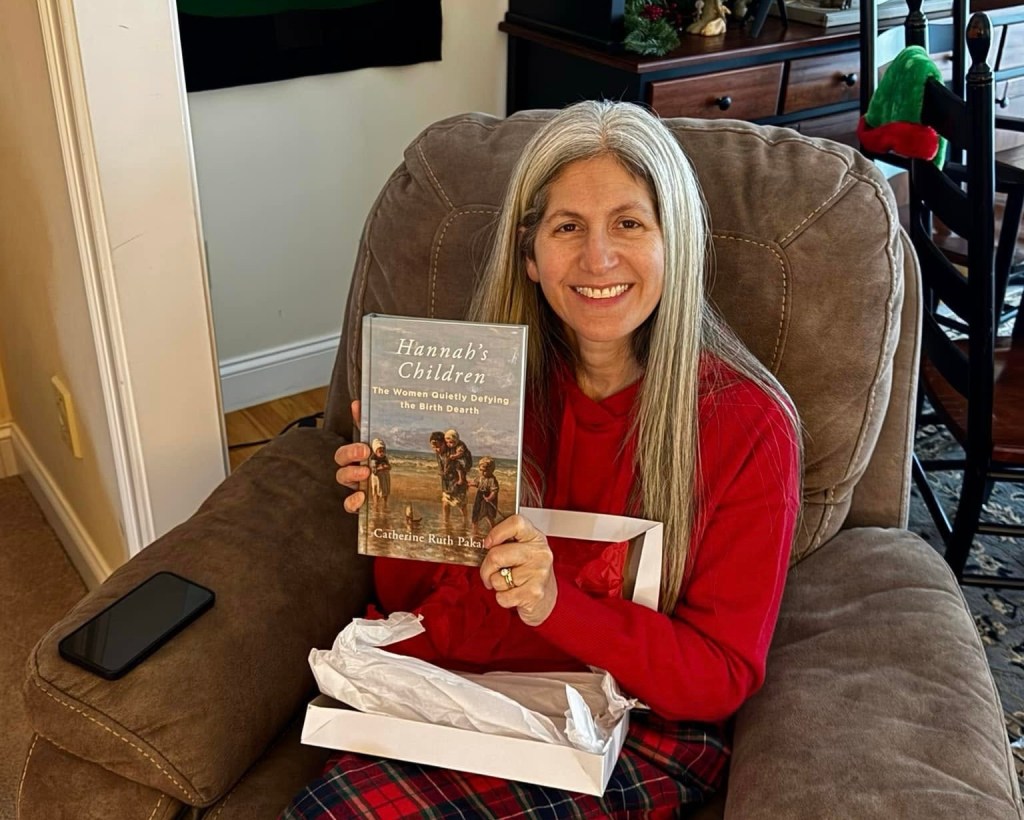
That’s me on Christmas morning, receiving this book as a gift. I put it on my Christmas list after hearing about it from my friend Manda’s brother. He was talking with Bobby and me at Manda’s daughter’s wedding, and he asked me if I had read it. I told him I had never heard of it. He was in the middle of it and found it interesting, being the oldest of seven. He thought it helped him to understand his mother a little bit better. I finished reading the book last week and wanted to share some thoughts. As I write this, I’m realizing that I always did find Manda’s family interesting.
I met Manda on my first day of high school. I was 13 years old and very quiet. I’ll never forget sitting next to her in French I. She said with a huge smile, “Hi! I’m Manda!” I said, “Hi. I’m Cheryl.” We communicated more at school over the years, but I think it wasn’t until senior year that I went to her house for the first time. I was shocked at how loud her family was and how different her home life was from my own. She shared a tiny bedroom with her two sisters. She had a younger brother who was my brother’s age and three older brothers. They had a large round banquet table in their kitchen, and a big Rottweiler dog wandering around drooling. They had cats and a steer. They had some kind of a beehive up on a counter and an extra large stove. I remember being amazed at the size of the jar of peanut butter in their pantry closet. Her mom was folding laundry with mounds of it piled up in a room. Her dad was working on something outside. They had a chicken coop. Manda actually collected eggs. There were siblings coming in and out of the kitchen talking loudly.
I was the oldest of three. My parents divorced when I was around nine years old. We lived a few streets away from my grandparents and spent a lot of time with them. I slept over my father’s house on Friday nights and sometimes on Wednesday nights. We watched a lot of TV and movies. My mother often had migraines and my brother and sister and I had to be very quiet so as not to disturb her.
While I was reading Hannah’s Children, I thought I would like to write about my own story. First, I’ll write a little bit about the book. The author, along with her colleague, interviewed 55 American women, with five or more children, to find out why they do what they do, and what they think it means for themselves, for their families, and for the nation. I enjoyed reading the stories of the women who were interviewed in the study, but I didn’t love the book because of the many discussions about economics. A large part of the book focuses on reasons for the declining population and whether or not government incentives work… blah blah blah
This is my own issue. I don’t enjoy economics discussions. I took many business classes because my work paid for them and I got an MBA degree. I prefer the exactness of math and accounting. I’ve never really liked (what I see as) the “guessing” in economics and statistics and sometimes science. Much of this book is concerned with why the population is declining and what can we do about it. The answers are unclear. And some of the proposed solutions are not likely to happen.
Still, I think this book is worth reading, especially for the focus on the benefits of large families and the value of children. These are things you don’t often hear about in the current culture. What this book has done for me, is it’s stirred up questions as to how and why I came to have a large family (by today’s standards.) It feels like I never thought about it before. I fit right into the parameters the author has set for her research subjects. I’m an American woman, college educated, with five or more children. I don’t exactly know what questions she asked her subjects, so I’ll just tell my story.
I didn’t always want to have a large family. In fact, on one of the early dates with my husband, I said, “I’m never getting married and I’m never having children.” This bothered him. He brought it up the next time I saw him. He wondered what we were doing. Why were we were bothering to go out? I realized that this was something I always told myself, but I didn’t really mean it. I was just scared. I was afraid to be a single mother like my mom. I grew up hearing that it was not good to be financially dependent upon someone else. I grew up hearing that marriage was a piece of paper. That if you’re gonna have sex, you need to use birth control. You don’t want to be trapped.
When I met Bobby, I was a non-practicing cradle Catholic, who was beginning to pray again and was willing to trust God, though I needed a lot more practice with that. I believed that God would take care of me no matter what, and I told Bobby that I would be open to marriage and children someday if it was God’s will.
I’ll save the story of how we came back to the Catholic Church for another day. I’ll skip to the Pre Cana (marriage preparation) Day we attended as an engaged couple. We heard many speakers, including one couple who talked about their experience with natural family planning. They said that the divorce rate for couples that practiced NFP was around 2%, way lower than the overall rate of 50% back then. (Ok, so I find some statistics interesting.) This stuck with me. I appreciated the communication involved in the practice and the respecting of a woman’s body. Why had I never heard of this before? I knew I had to find out more.
Bobby agreed to attend classes at that married couple’s house. We learned about methods, and that it was up to us to decide, using our consciences, whether or not to practice abstinence during the fertile time. My understanding was that we were to be generous, and I think they said not to avoid pregnancy unless you had a grave reason. I remember them saying that they had six children and wished that they had had more.
We had discussions before we were married and I recall wanting to stay home with them if we had children. I didn’t like the idea of being split between work and children. It seemed like a conflict of interest to me. I wouldn’t be able to give my whole self to either. Bobby agreed with it. We never said we’d have a big family. And I never thought it. Maybe we’d have two or three. We had both come from households with three children. I don’t think we wanted to have an only child.
We got married at 27 years old. We started tracking my cycles and after three months we began trying to achieve pregnancy. We based our budget on Bobby’s income and put all of my income into savings. We weren’t making that much money, but we also didn’t have many expenses. When I didn’t immediately get pregnant, I think I started to get worried. After five months I said, “We can travel and golf and do lots of service work.” I guess it was my way of saying that I’d be OK if we couldn’t have children. I was pregnant the next month.
Though it wasn’t easy, I loved being a stay-at-home mom. When Matthew was a year old, I started having a desire to have another baby. If Matthew was going to have a sibling, I wanted him or her to be close to his age. I was one year older than my brother and we were very close growing up. I conceived in March once again. Joseph was born almost exactly 2 years after Matthew. Matthew was born at 11:59 p.m. on December 11, 1998, and Joseph was born on December 12, 2000. It felt like déjà vu being pregnant during the advent season. I felt a little bit sad for Matthew, who received so much attention from us, to suddenly be without us and to see a new baby taking our attention from him. It helped me to hope in something that Saint John Paul II said about siblings being the best gift you could ever give a child. Now I know, from experience, that it’s true.
I took that message that I received about not preventing pregnancy unless you had a grave reason seriously. When I looked at myself and my motives for not wanting another child, I could see it was all fear. What if… what if… what if… I didn’t consider fear to be a good reason for not having another child. I knew I needed to develop a greater trust in God.
Baby Sarah was born 19 months after Joseph. Having three kids under four years old was tough sometimes. Bobby traveled a lot. I remember one weekend being alone with them and they were all sick and crying at the same time. I felt so helpless. I was probably crying with them. I often went on Bobby’s trips. Once, I carried Sarah in the baby carrier on my chest, while pushing the boys in the double umbrella stroller down bumpy Bourbon Street. It was not how I imagined it would be when I dreamed of going to New Orleans as a young adult.
Reality is often harder than I imagine, but it’s also better. If I was in charge of my life, I would’ve sold myself short. I have been blessed because I was open to not always getting my way.
With Sarah, and only Sarah, I practiced something I learned called ecological breast-feeding. I was told it would help to naturally space babies and it did work for me. My fertility didn’t return for 22 months. When I realized it was possible for me to take care of three kids, I began to trust that God would give me strength to take care of another. After Sarah, I had my first miscarriage. It was heartbreaking.
Rachel was born almost 4 years after Sarah. I had complications during labor which led to a blood transfusion, and my being extremely weak for the first month after she was born. I was advised by the midwives to see a doctor they recommended. He advised me to try not to have any more children.
Throughout my pregnancy, we had been building a custom house. It was stressful and time consuming. When Rachel was three months old, we moved from the small raised ranch we felt like we were outgrowing, to our giant dream home that was big enough for as many kids as we could have. Because we started having children when I was 29 years old, I didn’t expect we could have more than 10, nor did I know if we would want that many. We kind of took them one at a time. But you can see how my attitude had changed.
I got a second opinion from a new doctor. He did not see a reason why I couldn’t have more children. We decided to trust God and try again. I had another miscarriage. This one was more difficult than the first one because I found out that the baby had died, but waited months for my body to realize it, and have a natural miscarriage. In the book, there was a correlation made between the loss of a child and the value placed on human life. I had never thought of this before. Given my experience, these losses very well may have been the cause of my attitude change over the years.
I remember having a thought after 911 happened, that if Bobby had died in those towers, I would have wished we had had more children. So if imagining death can change your heart, I am sure that experiencing it would even more so.
We were blessed with healthy baby number five, Hannah. After she was born, I became very focused on decluttering and simplifying my life. Not just our possessions, but also my time. I cut back on some volunteer activities and dropped blogging, which I had done for five years. This was a busy time for me. Did I mention that I homeschooled? I guess I forgot about that. That’s a whole other story.
After Hannah, there was another miscarriage, similar to the second one. And then Mary was born. Fortunately, for me, I arrived at the hospital in labor and delivered her in less than one hour in the WETU room. It was an unexpected blessing, and she was a wonderful baby, and her siblings all love her. She’s our last living child and she will be turning 14 years old in May.
After Mary, there was another miscarriage. And then another, which was also a molar pregnancy. I was told to avoid pregnancy for a year in order to determine, through blood testing, that no cancer cells were forming. I did that, and I never became pregnant again.
My “children” are now 26, 24, 22, 18, 16, and 13. And there are five more souls that I believe were meant to be. I never considered helping the population rate. I never planned all of this. I think I was just led one day at a time. I think as some of the moms in the book may have expressed…that I have received more than I have given. I’m too lazy to search through the book for quotes. I’m just going by memory here. I am convinced that children are gifts. There is a lot of emotional pain that goes along with parenting. Hopefully, that pain has led me to spiritual progress. There is also so much joy.
In the book, there was mention of things people say to parents of many children. One that Bobby heard a lot when he told somebody that I was pregnant again was, “What, are you crazy?” Bobby’s response was always, “Not the last time I checked.”
The one I think I got the most was, “Wow. You must be busy!” I think my favorite comment that people have said is, “Enjoy them! It goes by fast!” That’s good advice because it’s true, our time here on earth is short. I’m grateful that I was led to do something I now believe I was made for, that I didn’t let fear get in the way of it, and that I am receiving grace every day to continue on my spiritual journey.
I want to wrap up this book study so I can move onto a new one. That doesn’t sound like a very good attitude, does it? This book is just not that exciting to me anymore. I started the study in January 2023. Shocking! And I will finish what I started.
Section IV opens up a can of worms that I don’t want to open. It seems to be pointing out differences of philosophies. Of which philosophies, I am not sure. I’m guessing Marxist ideas versus the ideas of the Catholic Church or Christianity in general.
He spends most of this section on what he calls, “Excursus on the Proletariat and Deproletarianization”. I don’t really want to go into it too much, so here’s my speedy overview:
Proletarians are people who are fettered to the process of work. They can be people from all levels of society, and there are different reasons why someone might be in this state of mind.
The author suggests combining three things in order to deproletarianize:
“…by giving the wage earner the opportunity to save and acquire property, by limiting the power of the state, and by overcoming the inner impoverishment of the individual.” (59)
Liberating a man from the process of work would require not only giving him opportunities to have activity that is not “work” (real leisure), but also that he’d be capable of leisure. He ends with the question: with what kind of activity is man to occupy his leisure?
In Section V, The main idea is that the core of leisure is celebration.
“Celebration is the point at which the three elements of leisure come to a focus: relaxation, effortlessness, and superiority of ‘active leisure’ to all functions.” (65)
He argues that celebration is man’s affirmation of the universe and his experiencing the world in an aspect other than its everyday one. The most intense affirmation of the world would be praising God. So, divine worship is the basis of celebration.
I thought this quote was interesting:
“ the vacancy left by absence of worship is filled by mere killing of time and by boredom, which is directly related to inability to enjoy leisure; for one can only be bored if the spiritual power to be leisurely has been lost.” (69)
I can remember being bored a lot as a kid. Sometimes I just didn’t know what to do with myself. There were many things I could do, but I couldn’t decide what I wanted to do. It makes sense to me that I would be confused or indecisive without having much self-knowledge, without a connection to God, and the trust in His guidance. I can still feel that way occasionally, but much less often as an adult because when I have an inability to enjoy leisure, I fill the time with work. This also makes me think about my YouTube problem. Is “the vacancy left by absence of worship filled by mere killing of time” in the form of scrolling on YouTube?
There is one word that has led me to procrastinate writing on the third section of this book study.
Acedia.
I’m fascinated by this word. I was shocked when I first came to it in this section. I wrote in the margin: This is a word of interest to me. And it is. I even received the book, The Noonday Devil: Acedia, The Unnamed Evil of Our Times, one Christmas because of my interest in this word.
I first heard of it when I was nursing a baby many years ago, and reading John Cassian’s Institutes on my phone. I also heard about it when watching a secular DVD about the seven deadly sins. There was a blurb about it being considered a deadly sin in the past. I think the intriguing thing is: how does a word, which so perfectly describes how I’ve often felt during my life, disappear from our language? Why did I never learn about it in school? And why, even though I’ve read books about it, do I lack the ability to talk about it?
It’s taken me almost 9 months to write this post, because I don’t feel I know enough about acedia to do it justice. But since I’m on an anti-procrastination kick, I’m gonna do it anyway. I’ll start with some quotes.
In a word, he does not want to be, as God wants him to be, and that ultimately means that he does not wish to be what he really, fundamentally, is.…
…acedia means that a man does not, in the last resort, give the consent of his will to his own being…
… sadness overwhelms him when he is confronted with the divine goodness eminent in himself…
Josef Pieper (44)
I have wondered if acedia could be the source of my “running away”. (I’m talking about when I go it alone, you know, being “too busy” to pray, when nothing is more important than being silent in the Presence of God.) As Timothy Gallagher explains in The Discernment of Spirits: …when we are least inclined to be “within”… it will appear easier and seem more welcome to find escape in diversion. (90) Is this acedia the cause?
Notice I chose the words “source” and “cause.” As I continue through this section, Pieper states that acedia was reckoned among one of the seven capital or cardinal sins. He says that capital certainly means “head,” but it also means “source” or “spring.“ He says, in this case, they are the sins from which other faults follow “naturally,” as from a source. Examples given are idleness, (a lack of calm, which makes leisure impossible) and despair, it’s twin fault. They both flow naturally from acedia.
This is so different from the language and meanings of today. I think now we use leisure and idleness interchangeably, when, in the past, they were more like opposites.
Leisure is only possible, when a man is at one with himself, when he acquiesces in his own being, whereas the essence of acedia is the refusal to acquiesce to one’s own being. Idleness and the incapacity for leisure correspond with one another. Leisure is the contrary of both.
Josef Pieper (46)
Here are some more descriptions of leisure:
A mental and spiritual attitude
An attitude of non-activity
Inward calm
That silence which is the prerequisite of the apprehension of reality
Not being “busy”
Letting things happen
A receptive attitude of mind
A contemplative attitude
Leisure is not the attitude of mind of those who actively intervene, but of those who are open to everything; not of those who grab and grab hold, but of those who leave the reins loose and who are free and easy themselves -– almost like a man falling asleep, for one can only fall asleep by “letting oneself go.“
Josef Pieper (47)
There is much more about leisure in this section. I think the main idea is it’s way more important than a break from work. It’s what makes us human.
A break in one’s work, whether of an hour, a day or a week, is still part of the world of work. It is a link in the chain of utilitarian functions. The pause is made for the sake of work, and in order to work, and the man is not only refreshed from work, but for work.
Josef Pieper (49)
This is very different from the concept of leisure, which does not exist for the sake of work. Here is what Aristotle says, about leisure:
A man will live thus, not to the extent that he is a man, to the extent that a divine principal dwells within him.
Aristotle (51)
And that is the end of my notes on section III. I can finally move onto section IV. I don’t think that this will be the end of my writing about acedia. There may be more to be said.
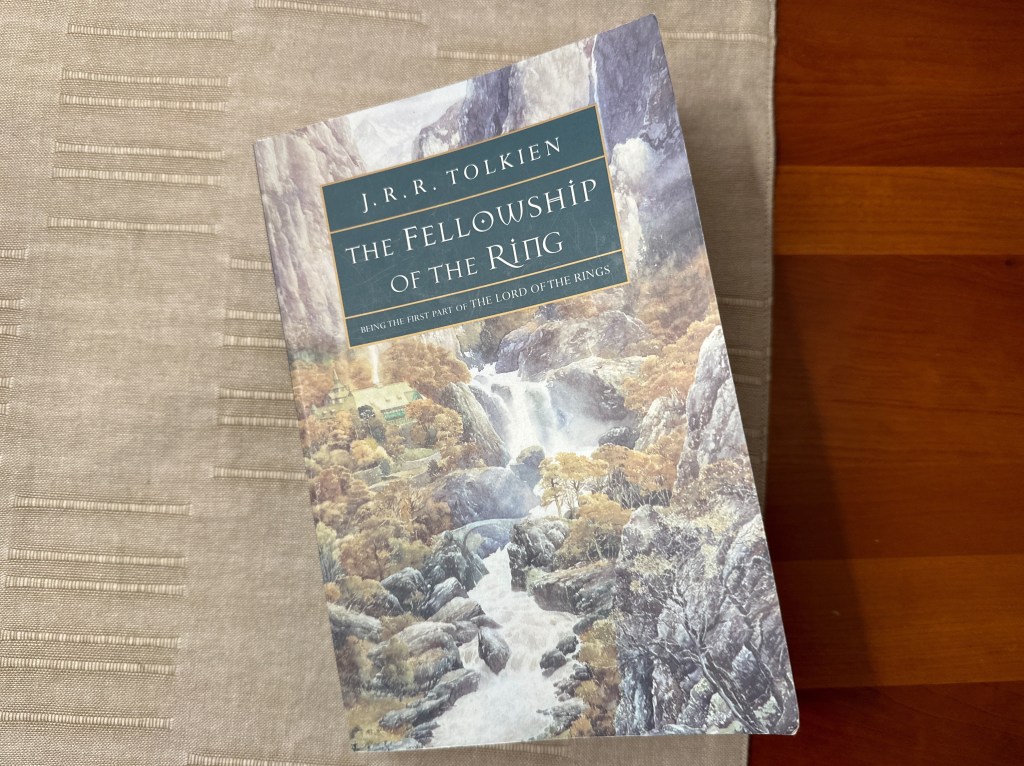
“Why, I feel all thin, sort of stretched, if you know what I mean: like butter that has been scraped over too much bread. That can’t be right. I need a change, or something.“
Bilbo Baggins
I love, love, love… this description of a feeling I know I’ve felt before, but would never have been able to articulate so well. Since my descriptions of feelings are usually basic: happy, sad, angry, etc. I find writing like this impressive.
I love the whole dialogue between Bilbo and Gandalf in this chapter, in which Gandalf is encouraging Bilbo to leave the ring behind.
“Don’t you want to?”
“Well, yes— and no. Now it comes to it, I don’t like parting with it at all, I may say.“
It reminds me of all the times I want to give up something that isn’t good for me or start doing something that is good for me. I can sense a tension… an invisible tug-of-war going on.
Today at Adoration, I was reminded of a time when I felt very free. And I recalled how surrendering is what brings me freedom. I let go, and listened, and felt great consolation. I find this dialogue so encouraging, because it gives me a visual of what I want to do.
Bilbo is resisting surrendering the ring. He argues, rationalizes, and whines. He says he’ll keep it.
“You will be a fool if you do, Bilbo,” he said. “You make that clear with every word you say. It has gotten far too much hold on you. Let it go! And then you can go yourself, and be free.“
Gandalf
Like Bilbo, I often go from…
“I will do as I choose and go as I please,”
to…
“And yet it would be a relief in a way not to be bothered with it anymore.”
before I am ready to leave the ring behind and feel the joy of walking out the door a free hobbit.
This section was long and what I am going to write here will definitely not be a summary, but rather some thoughts on a few points.
“Intellectual activity used always to be considered a privileged sphere, and from the standpoint of the manual worker especially, appeared to be a sphere in which one did not need to work.”
(Pieper, 25)
I have this attitude now. It’s why, when I am trying to avoid unnecessary work on Sundays, I save intellectual activity for then. I don’t consider it work. It’s fun. It’s relaxing and it does feel like a privilege. Sometimes, I try to squeeze a little of it in during the week too.
“Only those arts are called liberal or free which are concerned with knowledge; those which are concerned with utilitarian ends that are attained through activity, however, are called servile.”
(Aquinas, 37)
I went to a liberal arts college. I changed my major a number of times. I was a foreign languages major, an English major, a math major… I was indecisive. I remember talking with my parents when I was considering majoring in art history, and it was not encouraged. What was I going to do with that? They suggested accounting. I could get a job right away. The world always needed accountants. True, but I didn’t want to sit at a desk all day.
I think I was majoring in philosophy when I dropped out of college and became a factory worker. I worked nights. The good thing about it was that there were not a lot of people around, so it was quiet. I fondly remember the hum of the injection mold machines. It was a good atmosphere for thinking, and I could read books one sentence at a time in between doing my work. Or I could read on my breaks. So, for me, there has always been a distinction between work and intellectual activity. I wonder if that would have been different if I had been paid to read, think, or study.
“We are not simply to devote ourselves to politics and economics or to making a living, however valid these are in their own spheres. Pieper is quite aware of these things as elements in human life. But he recognizes that when everything human is defined in terms of utility or pleasure, the enterprise of knowing what we are loses its centrality in our lives.”
(James V. Schall, S.J., 11)
I included this quote from the foreword because I think it summarizes for me what Pieper is aiming at in this section. He seems very concerned with our world of “total work” and especially that the once privileged “liberal arts” are being called “intellectual work.” He goes into detail about how we acquire knowledge. He says that Kant claimed it’s from our effort alone. My own experience leads me to agree with Pieper and the ancients, that sometimes knowledge can be received without effort. He goes further to say that without this belief, we’d be ruling out things inspired and given to us. Knowledge would be the fruit of our own unaided activity. AS IF!!!
“… can a full human existence be contained within an exclusively workaday existence?”
(Pieper, 39)
Or can a man be a worker and nothing else? To be continued…
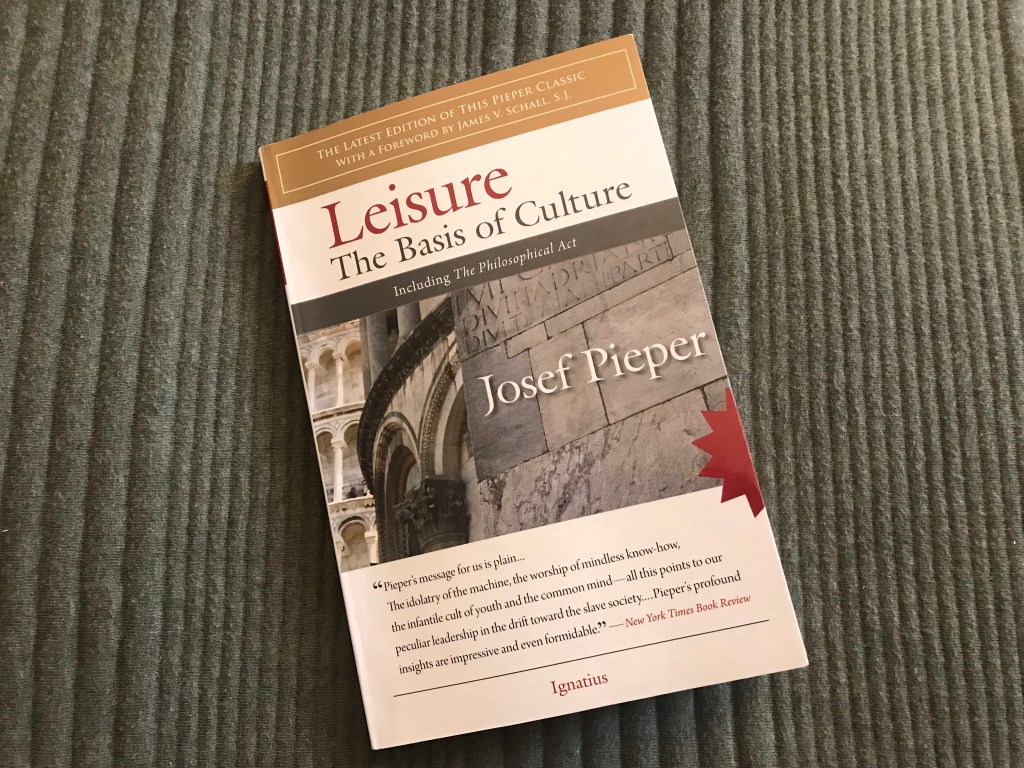
I’ll admit I chose this book because I thought it would give arguments for ideas with which I already agree. I thought it would convince me of how important it is that I make time for leisure. I’m talking about leisure in the Greek sense. Making it a priority to appreciate things of beauty, to contemplate… Not being a busy little bee all the time – full of ceaseless activity. My motivation in reading this book was to increase my knowledge, awareness, and conviction… and to hopefully act in accordance with these beliefs. After reading section I, my new hope is that it will not be too difficult to understand.
This book contains two parts: “Leisure: The Basis of Culture” and “The Philosophical Act.” According to the writer of the foreword, these were essays given by Josef Pieper in 1947.
This is my super-simplified synopsis of section I of the first essay:
People nowadays have very different values from people in the past. Also, the meanings of words have changed. On the surface it looks like today’s concepts of work and leisure are very different from the Greeks, the Romans, the people in the Middle Ages, and even the people living in 1947; but there is a deeper (not so obvious) change that I’m sure will be discussed in later sections. It is a changing view of our nature and the meaning of human existence.
Whoa! Hang on… I wasn’t expecting all of THAT! I guess I was kind of distracted when I started reading this in the summer.
So rather than getting “Ten Tips of How to Make Sunday a Day of Rest,” (Yes, I am too hooked on YouTube.) I may be diving into the deep end. (Picture me tapping my temple with my index finger à la Pooh Bear, saying… Think, Think, Think…)
“We are unleisurely in order to have leisure.” (20)
This is what Aristotle said. And to the Greeks, leisure was something much more than it means today. It wasn’t simply a little free time from the work that takes up most of your life. The author states that it is closely linked to the Christian and Western conception of the contemplative life. And he points out that the distinction between the “liberal arts” and “servile work” came from this notion of leisure. I found it interesting that he was certain that everyone was familiar with “servile work” at least, because they speak of it as unsuitable on Sundays and holidays. Not in 2023!
One last point: if we are to uncover what brought about this big change, looking at it only historically isn’t gonna cut it. We’re gonna get to the root of the problem. I’ll be interested to see where and how this goes.
 Unruffled Peace