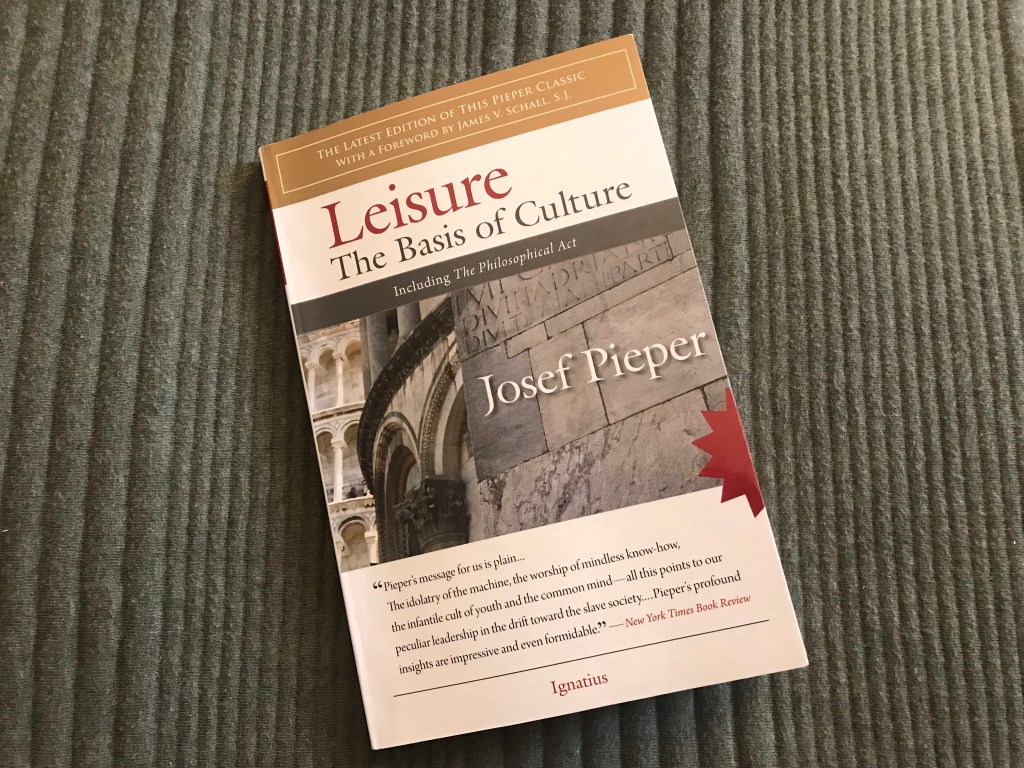
Book Notes: Leisure- The Basis of Culture, Sections IV & V

I want to wrap up this book study so I can move onto a new one. That doesn’t sound like a very good attitude, does it? This book is just not that exciting to me anymore. I started the study in January 2023. Shocking! And I will finish what I started.

Section IV opens up a can of worms that I don’t want to open. It seems to be pointing out differences of philosophies. Of which philosophies, I am not sure. I’m guessing Marxist ideas versus the ideas of the Catholic Church or Christianity in general.

He spends most of this section on what he calls, “Excursus on the Proletariat and Deproletarianization”. I don’t really want to go into it too much, so here’s my speedy overview:

Proletarians are people who are fettered to the process of work. They can be people from all levels of society, and there are different reasons why someone might be in this state of mind.

The author suggests combining three things in order to deproletarianize:

“…by giving the wage earner the opportunity to save and acquire property, by limiting the power of the state, and by overcoming the inner impoverishment of the individual.” (59)

Liberating a man from the process of work would require not only giving him opportunities to have activity that is not “work” (real leisure), but also that he’d be capable of leisure. He ends with the question: with what kind of activity is man to occupy his leisure?

In Section V, The main idea is that the core of leisure is celebration.

“Celebration is the point at which the three elements of leisure come to a focus: relaxation, effortlessness, and superiority of ‘active leisure’ to all functions.” (65)

He argues that celebration is man’s affirmation of the universe and his experiencing the world in an aspect other than its everyday one. The most intense affirmation of the world would be praising God. So, divine worship is the basis of celebration.

I thought this quote was interesting:

“ the vacancy left by absence of worship is filled by mere killing of time and by boredom, which is directly related to inability to enjoy leisure; for one can only be bored if the spiritual power to be leisurely has been lost.” (69)

I can remember being bored a lot as a kid. Sometimes I just didn’t know what to do with myself. There were many things I could do, but I couldn’t decide what I wanted to do. It makes sense to me that I would be confused or indecisive without having much self-knowledge, without a connection to God, and the trust in His guidance. I can still feel that way occasionally, but much less often as an adult because when I have an inability to enjoy leisure, I fill the time with work. This also makes me think about my YouTube problem. Is “the vacancy left by absence of worship filled by mere killing of time” in the form of scrolling on YouTube?

Solution: worship

Book Notes: Leisure- The Basis of Culture, III

There is one word that has led me to procrastinate writing on the third section of this book study.

Acedia.

I’m fascinated by this word. I was shocked when I first came to it in this section. I wrote in the margin: This is a word of interest to me. And it is. I even received the book, The Noonday Devil: Acedia, The Unnamed Evil of Our Times, one Christmas because of my interest in this word.

I first heard of it when I was nursing a baby many years ago, and reading John Cassian’s Institutes on my phone. I also heard about it when watching a secular DVD about the seven deadly sins. There was a blurb about it being considered a deadly sin in the past. I think the intriguing thing is: how does a word, which so perfectly describes how I’ve often felt during my life, disappear from our language? Why did I never learn about it in school? And why, even though I’ve read books about it, do I lack the ability to talk about it?

It’s taken me almost 9 months to write this post, because I don’t feel I know enough about acedia to do it justice. But since I’m on an anti-procrastination kick, I’m gonna do it anyway. I’ll start with some quotes.

In a word, he does not want to be, as God wants him to be, and that ultimately means that he does not wish to be what he really, fundamentally, is.

acedia means that a man does not, in the last resort, give the consent of his will to his own being…

… sadness overwhelms him when he is confronted with the divine goodness eminent in himself…

Josef Pieper (44)

I have wondered if acedia could be the source of my “running away”. (I’m talking about when I go it alone, you know, being “too busy” to pray, when nothing is more important than being silent in the Presence of God.) As Timothy Gallagher explains in The Discernment of Spirits: …when we are least inclined to be “within”… it will appear easier and seem more welcome to find escape in diversion. (90) Is this acedia the cause?

Notice I chose the words “source” and “cause.” As I continue through this section, Pieper states that acedia was reckoned among one of the seven capital or cardinal sins. He says that capital certainly means “head,” but it also means “source” or “spring.“ He says, in this case, they are the sins from which other faults follow “naturally,” as from a source. Examples given are idleness, (a lack of calm, which makes leisure impossible) and despair, it’s twin fault. They both flow naturally from acedia.

This is so different from the language and meanings of today. I think now we use leisure and idleness interchangeably, when, in the past, they were more like opposites.

Leisure is only possible, when a man is at one with himself, when he acquiesces in his own being, whereas the essence of acedia is the refusal to acquiesce to one’s own being. Idleness and the incapacity for leisure correspond with one another. Leisure is the contrary of both.

Josef Pieper (46)

Here are some more descriptions of leisure:

  • A mental and spiritual attitude
  • An attitude of non-activity
  • Inward calm
  • That silence which is the prerequisite of the apprehension of reality
  • Not being “busy”
  • Letting things happen
  • A receptive attitude of mind
  • A contemplative attitude

Leisure is not the attitude of mind of those who actively intervene, but of those who are open to everything; not of those who grab and grab hold, but of those who leave the reins loose and who are free and easy themselves -– almost like a man falling asleep, for one can only fall asleep by “letting oneself go.“

Josef Pieper (47)

There is much more about leisure in this section. I think the main idea is it’s way more important than a break from work. It’s what makes us human.

A break in one’s work, whether of an hour, a day or a week, is still part of the world of work. It is a link in the chain of utilitarian functions. The pause is made for the sake of work, and in order to work, and the man is not only refreshed from work, but for work.

Josef Pieper (49)

This is very different from the concept of leisure, which does not exist for the sake of work. Here is what Aristotle says, about leisure:

A man will live thus, not to the extent that he is a man, to the extent that a divine principal dwells within him.

Aristotle (51)

And that is the end of my notes on section III. I can finally move onto section IV. I don’t think that this will be the end of my writing about acedia. There may be more to be said.

Book Notes: Leisure-The Basis of Culture, II

This section was long and what I am going to write here will definitely not be a summary, but rather some thoughts on a few points.

“Intellectual activity used always to be considered a privileged sphere, and from the standpoint of the manual worker especially, appeared to be a sphere in which one did not need to work.”

(Pieper, 25)

I have this attitude now. It’s why, when I am trying to avoid unnecessary work on Sundays, I save intellectual activity for then. I don’t consider it work. It’s fun. It’s relaxing and it does feel like a privilege. Sometimes, I try to squeeze a little of it in during the week too.

“Only those arts are called liberal or free which are concerned with knowledge; those which are concerned with utilitarian ends that are attained through activity, however, are called servile.”

(Aquinas, 37)

I went to a liberal arts college. I changed my major a number of times. I was a foreign languages major, an English major, a math major… I was indecisive. I remember talking with my parents when I was considering majoring in art history, and it was not encouraged. What was I going to do with that? They suggested accounting. I could get a job right away. The world always needed accountants. True, but I didn’t want to sit at a desk all day.

I think I was majoring in philosophy when I dropped out of college and became a factory worker. I worked nights. The good thing about it was that there were not a lot of people around, so it was quiet. I fondly remember the hum of the injection mold machines. It was a good atmosphere for thinking, and I could read books one sentence at a time in between doing my work. Or I could read on my breaks. So, for me, there has always been a distinction between work and intellectual activity. I wonder if that would have been different if I had been paid to read, think, or study.

“We are not simply to devote ourselves to politics and economics or to making a living, however valid these are in their own spheres. Pieper is quite aware of these things as elements in human life. But he recognizes that when everything human is defined in terms of utility or pleasure, the enterprise of knowing what we are loses its centrality in our lives.”

(James V. Schall, S.J., 11)

I included this quote from the foreword because I think it summarizes for me what Pieper is aiming at in this section. He seems very concerned with our world of “total work” and especially that the once privileged “liberal arts” are being called “intellectual work.” He goes into detail about how we acquire knowledge. He says that Kant claimed it’s from our effort alone. My own experience leads me to agree with Pieper and the ancients, that sometimes knowledge can be received without effort. He goes further to say that without this belief, we’d be ruling out things inspired and given to us. Knowledge would be the fruit of our own unaided activity. AS IF!!!

“… can a full human existence be contained within an exclusively workaday existence?”

(Pieper, 39)

Or can a man be a worker and nothing else? To be continued…

Book Notes: Leisure-The Basis of Culture, I

I’ll admit I chose this book because I thought it would give arguments for ideas with which I already agree. I thought it would convince me of how important it is that I make time for leisure. I’m talking about leisure in the Greek sense. Making it a priority to appreciate things of beauty, to contemplate… Not being a busy little bee all the time – full of ceaseless activity. My motivation in reading this book was to increase my knowledge, awareness, and conviction… and to hopefully act in accordance with these beliefs. After reading section I, my new hope is that it will not be too difficult to understand.

This book contains two parts: “Leisure: The Basis of Culture” and “The Philosophical Act.” According to the writer of the foreword, these were essays given by Josef Pieper in 1947.

This is my super-simplified synopsis of section I of the first essay:

People nowadays have very different values from people in the past. Also, the meanings of words have changed. On the surface it looks like today’s concepts of work and leisure are very different from the Greeks, the Romans, the people in the Middle Ages, and even the people living in 1947; but there is a deeper (not so obvious) change that I’m sure will be discussed in later sections. It is a changing view of our nature and the meaning of human existence.

Whoa! Hang on… I wasn’t expecting all of THAT! I guess I was kind of distracted when I started reading this in the summer.

So rather than getting “Ten Tips of How to Make Sunday a Day of Rest,” (Yes, I am too hooked on YouTube.) I may be diving into the deep end. (Picture me tapping my temple with my index finger à la Pooh Bear, saying… Think, Think, Think…)

“We are unleisurely in order to have leisure.” (20)

This is what Aristotle said. And to the Greeks, leisure was something much more than it means today. It wasn’t simply a little free time from the work that takes up most of your life. The author states that it is closely linked to the Christian and Western conception of the contemplative life. And he points out that the distinction between the “liberal arts” and “servile work” came from this notion of leisure. I found it interesting that he was certain that everyone was familiar with “servile work” at least, because they speak of it as unsuitable on Sundays and holidays. Not in 2023!

One last point: if we are to uncover what brought about this big change, looking at it only historically isn’t gonna cut it. We’re gonna get to the root of the problem. I’ll be interested to see where and how this goes.